Most clinical encounters benefit from iterative assessment,
and all benefit from the readiness to iterate when new information
demands it.
This is a communication format, not a thinking process.
An examination finding can send you back to the history, and one answer in the history can raise new questions within the history itself.
What learners think vs. what actually should be
The Learner's Mental Model
- Take full history in perfect order
- Examine from head to toe
- Then think about the diagnosis
Good Clinical Practice
- Ask history: form early hypotheses
- Examine: findings change your thinking
- Return to history with new questions
- Re-examine with a focused purpose
- Refine hypothesis: repeat as needed
The Iterative Loop: not a line, a cycle
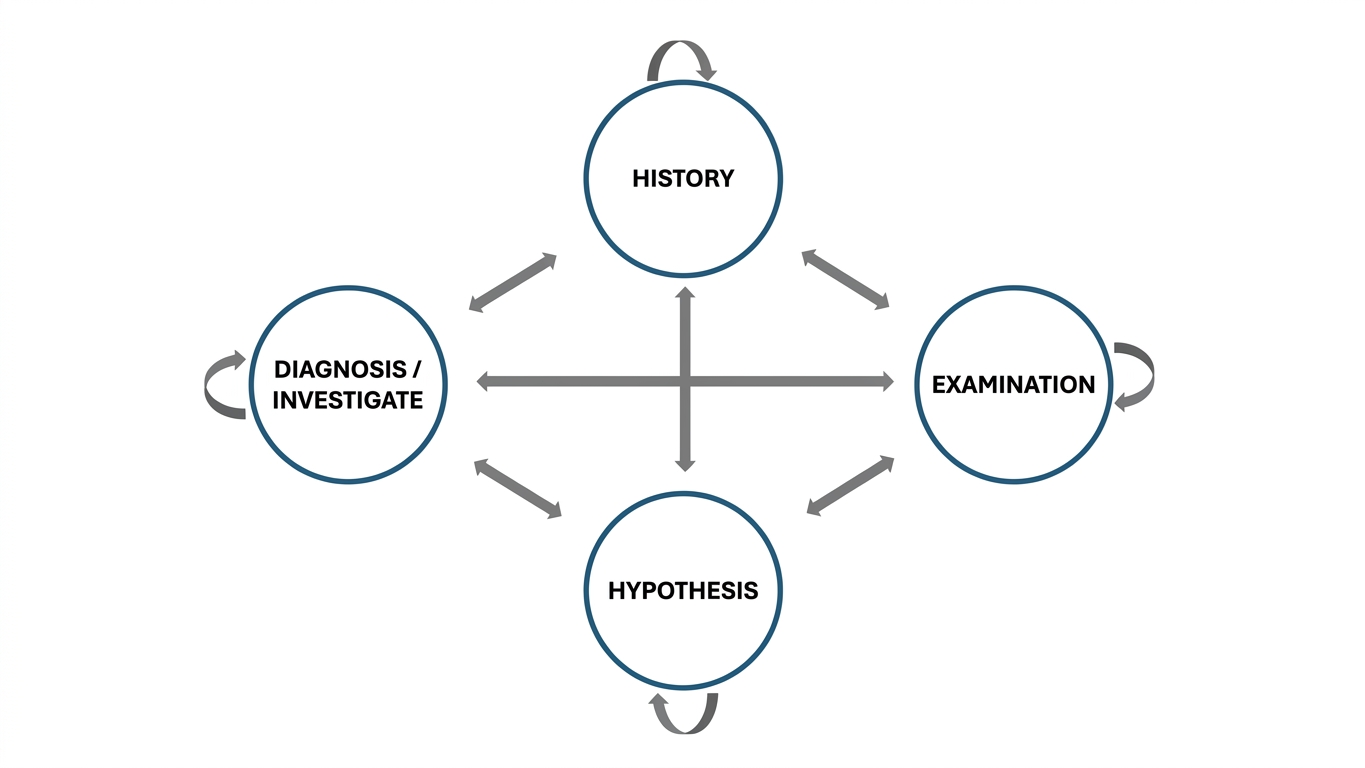
Clerking format vs. clinical thinking: do not confuse them
A communication structure
The structured history and examination format taught in medical school is designed for clear, reproducible communication, to ensure nothing is omitted when presenting a case or writing a note. It is a valuable tool for this purpose.
A flexible reasoning process
Clinical thinking is priority-based, hypothesis-driven, and iterative. It follows the evidence, not the headings. The order changes based on what the patient tells you, what you find, and what hypothesis you are currently testing.
Clerking is iterative, not sequential
History and Examination Inform Each Other
What you find changes what you ask. What you ask changes what you look for. A finding on examination is a trigger for new, targeted questions.
History Is Not Taken in Presentation Order
The clerking format (presenting complaint, history of presenting complaint, past history, family history) is a communication structure, not a thinking sequence. If a new hypothesis arises mid-history, pursue it immediately.
History Is Often Taken More Than Once
Parents remember details later. Patients give incomplete information initially. Sensitive issues (such as safeguarding concerns, mental health, or substance use) may only be disclosed when sufficient rapport has been established, often at a later point in the encounter or on a subsequent visit. Revisiting history is not a sign of failure. It is good clinical practice.
Physical Examination Is Repeated
In acute and evolving presentations, a single examination is rarely sufficient: re-examination at defined intervals or after interventions is part of safe management.
Clinical Reasoning Is a Loop, Not a Line
History → Exam → Hypothesis → More History → Focused Exam → Refined Hypothesis → Investigation → Reassessment. This cycle may repeat several times. That is not inefficiency; that is how diagnoses are actually made.
Focused Re-examination Is a Clinical Skill
Re-examination is not just repetition: it is purposeful reassessment with a specific question in mind. What you are looking for on the second examination is different from what you looked for on the first.
Suspected hematological malignancy → re-check for lymphadenopathy and organomegaly over serial assessments.
Suspected nephrotic syndrome → reassess edema distribution daily.
If a new clinically relevant idea comes to mind, pursue it before the
moment passes.
The question that occurs to you mid-examination may be the one that
makes the diagnosis.
Common errors from linear thinking
Clinical clerking is not a sequence to complete but a hypothesis-driven loop to sustain, where new findings from any source may reopen history, re-examination, or both, and the endpoint is not certainty but sufficient clarity for a safe decision.